



Castles in Slovakia
Accommodation in Slovakia
List of tourist attractions in Slovakia
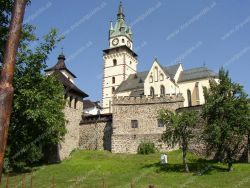
Kremnica Castle
Town castle Kremnica is the complex of buildings built and fortified in 13th - 15th century. The building of St. Katharine Church is dominant; it was built in Gothic style. In present time the castle is the residence of Coin and Medal Museum. Exposures: Baroque sculptures Kremnica bells Town defence Archaeological researches of the castle Opening hours June to September (Tuesday - Sunday) 08.30 - 12.00 13.00 - 17.30 October to May (Tuesday - Saturday) 09.00 - 12.00 13.00 - 16.30
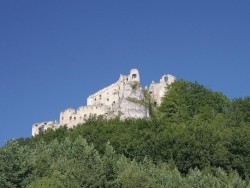
LIETAVA CASTLE
The castle was built in the second half of the 13th century, the first reference about it dates back to 1318. In the second half of the 16th century it was gained by the Thurzos and they owned it till its downfall in the years 1698-1770. Since that time, it has continuously run riot. The fortifications, the walls of the donjon, remainders of palaces for living and of the chapel have been preserved. At the beginning of the 18th century the castle burnt down, it lost its defensive function and it ran riot. At present times, ruins stand on its place, however, conclusive evidence has been preserved...
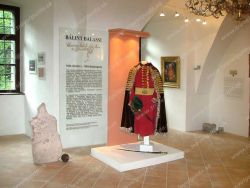
BLUE ROCK CASTLE
The Blue Rock castle was built in the 12th century by an important and weighty Ugrian family of the Balassas that lived here till the half of the 19th century. An important Renaissance poet and an anti–Turkish fighter, Bálint Balassi /1554-1594/, comes of this family. The last owner, Countess Gabriela Almássy sold the castle with manor-house and neighbouring lands to the Czecho-Slovak State in 1923. The area of the castle is created by ruins of the Gothic castle from the 12th century and of a Baroque castle from 1730 that is a seat of a museum at present. Part of the Baroque castle is...
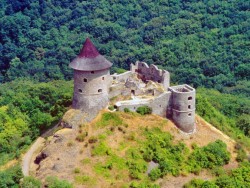
ŠOMOŠKA CASTLE
Šomoška Castle built of unconventional hexagonal basalt columns is unique among the Slovak castles. Its scenic beauty ranks it among the most beautiful castles in Slovakia. It is located on the Hungarian border above the Hungarian village Somoskő. The castle was built in the early 14th century by Kacsics Dynasty. In 1323 King Charles-Robert donated castle to Thomas Széczényi. During his era, the castle was a bustling centre of social life. The original base of the castle was a building that with a wall closed the relatively small triangular courtyard. In the 15th century, when firearms...
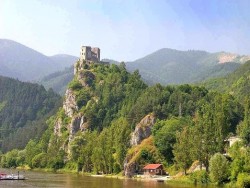
STREČNO Castle
The romantic ruins of the Strečno castle dominate above the ribbon of the river Váh as the symbol of feudal powers on the middle part of the river Váh. Although being in ruins already for three centuries, its preserved architecture is proof of development of mediaeval fortress from the period of Gothic until the period of Baroque. Although the history of the castle began only in the middle of the 14th century, the first inhabitants came here far earlier – the archaeological findings proved the settlement of the castle hill already in the earlier Bronze Age. The explicit written proof about...
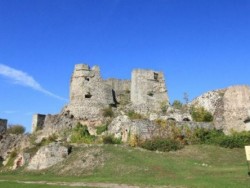
Levice Château
The château was built in the second half of the 13th century originally as the château of Tekov Borough. It was rebuilt several times. After 1542 if was changed into army anti-Turkish fortress. There is Tekov Museum in the château from 1958. Expositions: Exhibitions from collection of museum on certain topics and authors
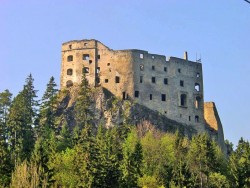
Likava Castle Ruins and Museum
The ruins of the Likava Castle tower above the village Likavka near the town of Ruzomberok in the Liptov Region. The first written reference comes from the first half of the 14th century, but it is likely that it was built back in 12th to 13th century. The castle originally served to guard the trade route from the region of the river Váh (Považie) to Orava continuing to Poland. The castle consists only of walls built on the highest point of the rock. Last period of the expansion of the castle was during the reign Thokoly when the castle was rebuilt and luxuriously furnished. In 1670 it was...

Banská Bystrica Town Castle
The town castle was once formed by several ancient buildings in the central Slovakian metropolis Banská Bystrica. Its task was to protect the income proceedings of copper and silver mining for the royal treasury. The town castle was built gradually. The parish church was built as the first structure in the 13th century and fortifications were added to it in the 15th century. Earth ramparts and palisades were later replaced by tall stone walls fortified by bastions and a water dike. In the 16th century, the Turkish threat called for further fortifications. Only a quarter of the original town...

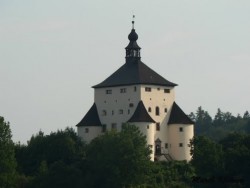
NEW CASTLE - BANSKÁ ŠTIAVNICA
The beautiful view of the historic center of Banská Štiavnica is just one of the experiences offered by a visit to the New Castle. A six-storey Renaissance fortification building built in 1564-1571 as an anti-Turkish watchtower in the system of fortifications of mining towns. It also served as a city clock. It is currently part of the Slovak Mining Museum. The exhibition presents the history of anti-Turkish wars in Slovakia. The visitor will learn about the importance of Banská Štiavnica and other mining towns in the fight against the Turks, about important periods during the Turkish expansion...
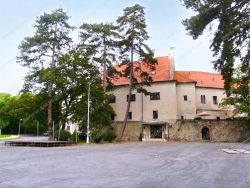
PEZINOK CASTLE
Pezinok Castle is a Renaissance castle on the outskirts of the city in the park, originally a medieval residence with fortifications using water sources - a water castle. It is located at the southeastern foot of the Little Carpathians, in the town of Pezinok. Already before 1271, they built a castle in Pezinok, which, like the other castles in the area, was attacked by the troops of Přemysl Otakar II. It was surrounded by two ditches filled with water from the Cajlan brook. There were two drawbridges above them. In the 17th century, the castle was abandoned and repaired in 1718 Ján Pálffy....
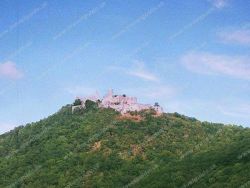

Smolenice Castle
The Smolenice Castle (Smolenický zámok) is a castle in the eastern slope of the Little Carpathians, near the town of Smolenice in Slovakia. The castle was build up in the half of 15th century, but it was destroyed during the Rakoci's uprising and Napoleanic wars. In 1777 the count Jan Palffy from Pezinok inherited the entire Smolenice but did not reside in the castle due to its poor condition and lack of money for rebuilding it. The castle was only rebuilt up in the 20th century, by order of the count Jozef Palffy. The main building has two wings and a tower, and is made of ferroconcrete....

Old Castle - Banska Stiavnica
The castle complex of the Old Castle can be found in the center of Banská Štiavnica, directly above Trinity Square. His piece of Romanesque architecture can be considered the oldest preserved architectural monument in the town of Banská Štiavnica. It dates from the first years of the 13th century, when a community of miners built a large three-nave church here, dedicated to the Virgin Mary. At the end of the 15th century, the church was enlarged and fortified with walls. At the time of the Turkish danger in the middle of the 16th century, an extensive renovation of the building was carried...
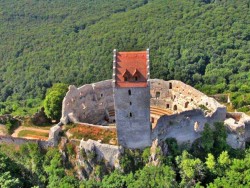
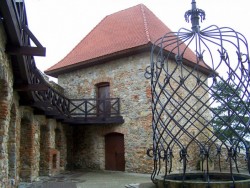
Vazul tower
The site of the Vazul Tower was once a fortress, which was gradually rebuilt. The original tower was two-story, with two entrances: one entrance led to the tower from the courtyard and the other from the castle bell tower. There are portholes in the lower part of the tower and 3 windows on the first floor. We know from older photographs that there was no saddle roof on the tower before, it is the result of the last reconstruction. Below the tower is a late castle prison. The tower and the castle wall surround a small courtyard, here stands the castle well, which was about 60 m deep.
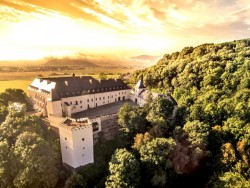
Vígľaš Castle
Vígľaš Castle is located above the Slatina River near the village of Vígľaš in the Detva district, approximately 13 km from the town of Zvolen. The castle was built in the 14th century at a strategic location where the road from Zvolen emerges from a narrow gorge through which the Slatina River flows. In the 16th century, Vígľaš Castle played an important role in the defense of the central Slovak mining towns against Turkish raids. Although the Turks damaged the castle, they never managed to conquer it. After the Turkish threat had been repelled, the castle underwent reconstruction...
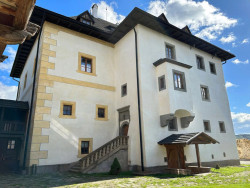
Water Castle in Hronsek, Renaissance mansion
The water castle is the oldest preserved structure in the village of Hronsek. This Gothic-Renaissance building dates from the 14th century. At the end of the 16th century, it was rebuilt and fortified against Turkish raids. The building had a fortification consisting of a defensive wall with four towers and a moat with a drawbridge. The castle belonged to the Géczyovsk family, later it was also owned by other noble families. Later, the Water Castle was used for evangelical services, the cellars were once used as a prison and during the Rákoczio uprising (at the beginning of the 18th century)...
Our tips
64.50 €
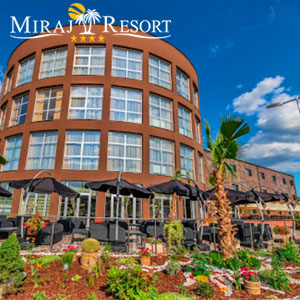
32.50 €
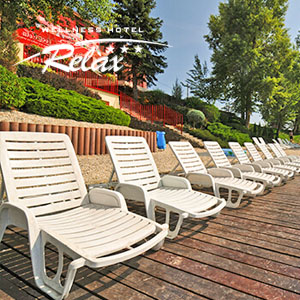
28.00 €


HEPEX Slovakia s.r.o.
All rights reserved.
Webdesign Pixa.sk
Change cookie settings