



Sacral monuments and pilgrimage sites in Slovakia
Accommodation in Slovakia
List of tourist attractions in Slovakia
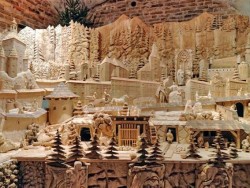
Betlehem in Banská Štiavnica
Bethlehem in Banska Stiavnica is one of the largest wooden, movable Bethlehem in Slovakia. The carving shows the form of the history, development and tradition of the historic mining town of Banska Stiavnica. Woodcarving is composed of three parts, respectively is divided into three themes. The first motive is mining gold and silver. The knockers as underground rulers are the basis of this section. You can see mining, gold panning and washing ore and exported from its mines and subsequent crushing, screening and heating process. There is also shown coinage, mining so called Gapel driven by horsepower...

Archiepiscopal Palace
The Archiepiscopal Palace in Trnava is an impressive historic residence that once served as the seat of the Archbishops of Esztergom. This Baroque building with its elegant façade and rich decoration is a symbol of the city’s spiritual and cultural strength and belongs among its most important monuments.

Baroque Church of the Holy Ghost and Monastery Minorits
The church and monastery buildings complex in Levoča was built between 1748 -1755 on the site of the oldest Levoča church, which was demolished in 1747 after a fire. It is one of the few preserved Baroque churches in Spiš region. Set of monastic buildings has a U-shaped footprint. The church has one nave; in the backside there is a brick Emporia with an organ. The facade of the church features a mural with symbols of Faith, Hope and Love.

Basilika in Esztergom
The most famous monument of Esztergom is the world-famous basilica. The basilica is 118 m long and 40 m wide, the internal height of the dome is 71.6 m. Its front is decorated with eight 22 m high Corinthian columns. The present basilica, which dominates the city, was initiated in 1822 at the initiative of the Slovak Archbishop Alexander Rudnay. It was solemnly consecrated on August 31, 1856 and fully completed in 1869. It was built according to the model of St. Peter in Rome on the site of the former cathedral church, which was devastated in 1543. An important part of the complex are two side...
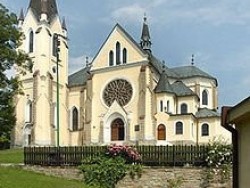
Basilica of the Blessed Virgin Mary
Basilica of the Visitation of the Blessed Virgin on Marianska hora in Levoca is one of the oldest places of pilgrimage in eastern Slovakia. The pilgrimage takes place here every year on July 2. The chapel was an expression of gratitude of Spis residents for their rescue during the Tartar invasion in the years 1241 - 1242. The first chapel which was later gave to repair by Levoca parish priest Henrich was built in 1247 there. Marian Feast of the Visitation is associated with the arrival of the Franciscans - Minorits to Levoča in 1311. In 1470 Servác pastor had the chapel Gothic church to rebuild,...
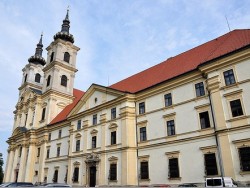
Basilica of Our Lady of Seven Sorrows
The Basilica of Our Lady of Seven Sorrows in Šaštín is one of the most important pilgrimage sites in Slovakia. This monumental Baroque church, dedicated to the Patroness of Slovakia – Our Lady of Seven Sorrows, impresses with its magnificent architecture and rich interior decoration. Every year, thousands of pilgrims come here to venerate the miraculous statue of the Virgin Mary and to find spiritual strength in the peaceful atmosphere of the basilica. The surroundings invite visitors to stroll and relax, making Šaštín a popular destination not only for believers but also for lovers of...
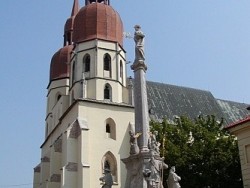
Basilica of St. Nicholas
The Basilica of St. Nicholas is one of the oldest and most important sacred monuments in Trnava. Built in the first half of the 14th century as a Gothic church, it still preserves the atmosphere of the Middle Ages. Its interior is adorned with precious altars and ribbed vaults, reflecting the artistic spirit of the past. The basilica is also closely connected with the veneration of the Virgin Mary of Trnava – the city’s protector, whose miraculous image attracts pilgrims from all over Slovakia. A visit here offers both spiritual peace and a glimpse of unique architectural heritage.
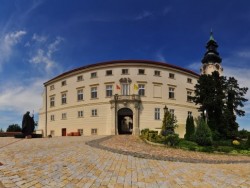
Bishop’s Palace
The Bishop’s Palace, a dominant landmark of Nitra’s Upper Town, is the historic residence of the bishops of Nitra, with origins dating back to the Middle Ages. Its current Baroque-Classical appearance was shaped during renovations in the 18th and 19th centuries. Located right next to St. Emmeram’s Cathedral, the palace forms an impressive complex within the Nitra Castle area. It still serves as the residence of the bishop of Nitra and ranks among the city’s most important religious and cultural monuments.
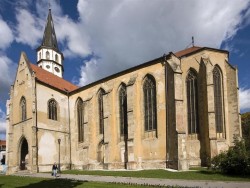
Church of St. James
Church of St. James in Levoča, originally in gothic style, is the second largest church in Slovakia, national monument and a building of a particular art-historical significance. Originally the church from around the year 1280 stands on its place. The current church was built from the first third of the 14th century. The church was modified at the end of the 15th and early 16th century, partly in the 17th century. In the temple you will find the ornamental late-Gothic painting, several frescoes groups: on the northern wall of the left side of the ship in two rows of seven works of mercy...
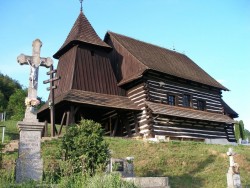
Church of St. Luke the Evangelist (Brezany)
Greek Catholic Church of St. Luke the Evangelist from 1727 in the village Brezany, district Prešov is a historic wooden sacral building in Slovakia. Restoration of the church was made in the second half of the 18th century. It is currently also a branch of the Roman Catholic parish in nearby Bajerov. From an architectural point of view it regards as an atypical three-part log-house with a strong influence of Gothic Roman Catholic religious architecture. The windows are made by deep cuts in two adjacent beams. Glazed opening is provided with a simple iron grate. Baroque iconostasis dates from...
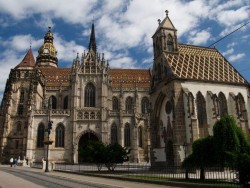
St. Elisabeth Cathedral
The St. Elisabeth Cathedral is a Gothic cathedral in Košice. It is Slovakia's biggest church. The record on the existence of Košice dating from 1230 in connected with that on the existence of the rectory church. In the process of the settlement's transformation from a rural community into a town, all its periods of success and failures had been reflected on St. Elizabeth's Cathedral. According to historic data the present-day cathedral was built on the site of an edifice of older date which was consecrated to St. Elisabeth as well. It was referred to in the document of Pope Martin...

St. Martin's Cathedral in Bratislava
The St. Martin's Cathedral (Slovak: Katedrála svätého Martina) is a cathedral in Slovakia's capital, Bratislava. It is situated at the western border of the historical city center below Bratislava Castle. It is the largest and finest, as well as one of the oldest churches in Bratislava, known especially for previously being the coronation church of the Kingdom of Hungary. Currently, it is the cathedral of the Archdiocese of Bratislava. From 1995 to February 2008 it was the concathedral of the Archdiocese of Bratislava-Trnava.
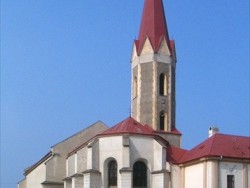
Dominican Church of the Assumption of the Virgin Mary
The Dominican Church of the Assumption of the Virgin Mary in Košice is one of the oldest preserved sacred buildings in the city. Its origins date back to the first half of the 13th century, when the Dominicans arrived in Košice. Originally Romanesque, the church gradually expanded and acquired a Gothic appearance, which remains its dominant architectural style. A distinctive feature is the square tower rising above the historic city center. Inside, visitors can admire valuable Baroque altars and several artworks documenting the rich history of the Dominican order in Košice. The church was...
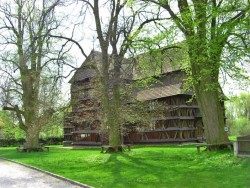
Wooden evangelical articular church in Hronsek
5 evangelical articular churches have been preserved in Slovakia. One of these five churches is the wooden evangelical articular church in Hronsek. It is one of the unique wooden churches, which are an important part of the cultural heritage. They are built exclusively of wood without the use of a single nail and are characterized by a unique originality, as is the wooden church in the village of Hronsek, which was built in 1726 on the basis of the Sopron Assembly from 1681. It is the only one of its kind in Horehronie. Its capacity is 1100 seats. The church has 30 windows in the shape of a...
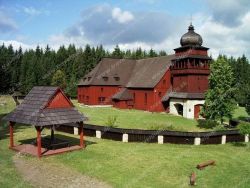
Wooden church in Svaty Kriz
Approximately 14 km from Liptovsky Mikulas in the village of Svätý Kríž is a wooden articular evangelical church, which is one of the largest wooden buildings in Central Europe. The church was originally built in Paludzi. The relocation began in 1974 and the ceremonial celebration of the reconstructed church was on 22 August 1982. The church is the last, undoubtedly the most significant artistic expression of Slovak wooden ecclesiastical architecture.

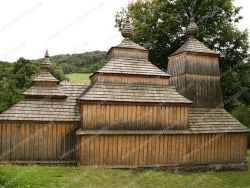
Saint Michael's Wooden Church - Príkra
The Church of St. Michael the Archangel, also called the Wooden Church or Church, is a Greek Catholic wooden church in the village of Příkra. It has been a national cultural monument since 1968. It stands on an elevated stone foundation, which balances the slope of the terrain to the west. The entrance to the vestibule is from the west side. A special element is the covering of the roof spaces between the tower and the nave and between the nave and the sanctuary. The temple was reconstructed in 1902 and in the years 1946-1947. The current appearance is the result of reconstruction work in the...
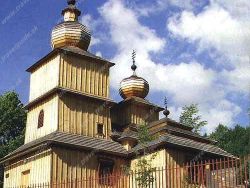
Saint Paraskieva's Wooden Church - Dobroslava
The Church of St. Paraskieva is a Greek Catholic wooden church located in the village of Dobroslava in the Svidník district in the Prešov region. The church dating from 1705 is a three-room building in the shape of a cross with a transverse nave standing on a high stone foundation. Its characteristic appearance includes three unequally high domes topped by towers with mines. The church area is surrounded by a fence. There is a cemetery inside the complex. The church was rebuilt in 1880 and finally in 1932, when two side chapels were attached to the building, which gave it its current appearance....
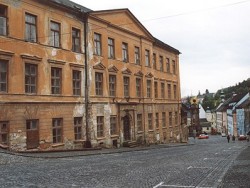
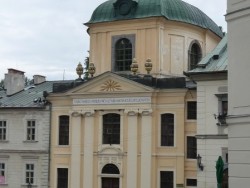
Evangelical Church
The Evangelical Church in Banská Štiavnica is one of the city’s most remarkable sacred monuments. Built between 1794 and 1796 in the Classicist style, it was designed by the renowned architect Jozef Taller. Its most striking feature is the circular rotunda layout complemented by a two-tower façade that gives the church a majestic appearance. The interior is spacious and centrally arranged, dominated by the main altar with its pulpit. Today, the Evangelical Church serves not only as a place of worship but also as a vibrant cultural venue, hosting concerts and important social events. A visit...
Our tips
104.50 €
69.50 €
30.90 €


HEPEX Slovakia s.r.o.
All rights reserved.
Webdesign Pixa.sk
Change cookie settings