


BRATISLAVA CASTLE
back to Attractions BratislavaBratislava - area: Little Carpathians - region: Bratislava and surroundings
Type of interest: Castles

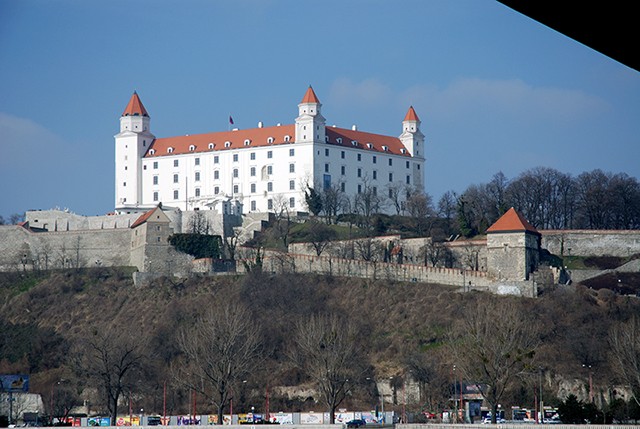
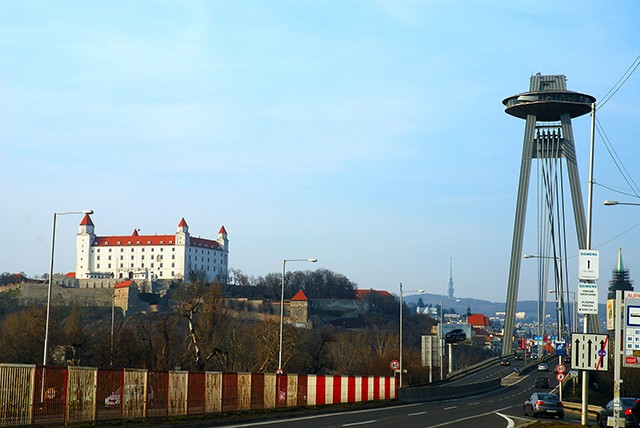
This majestic castle is towering on a rocky spur of the Male Carpathy massif, 85 metres above the level of the river Danube forming panorama of Slovak capital city. Its history comes back to the time of Celts and Romans. The castle hill was an important place especially for the fact it was on the crossroads of important business routes, it was protected by the massive river from one side and by deep forests of the Male Carpathy from the other. A person, who built the fortification, knew how important the crossing over the river was and he was the whole area owner.
This massive rectangular block building with four corner spires stands on a strategic point that had already been inhabited in Celtic and Velka Morava times. In the 9th century there was a chateau building and basilica on the site of today's castle area. The architecture of the castle is mainly affected by amendments and reconstructions in Gothic and Renaissance periods and during Maria Teresa reign. Since the 16th century when Bratislava had become Hungarian coronation city for 200 years, the castle was the residence of the king, Hungarian parliament used to have meeting there and the coronation jewels of Hungarian kings were placed in the coronation tower.
When the royal court had moved to Vienna there was General seminar based in the castle where many outstanding scientists were studying. In 1811 the castle burnt down. Reconstruction took place as late as in the 60s of this century. At present time there are expositions of Slovak National Museum (History Museum and Museum of Music), representative rooms for the president and the parliament of the Slovak Republic based in the castle.
The castle and surrounding area were declared National culture heritage in 1961.
Other accommodations near BRATISLAVA CASTLE

Ibis Bratislava Centrum is located in the historical centre of Bratislava, at the entrance to pedestrian...
from 24.50 €
(person / night)

Park Inn by Radisson Danube Hotel is located in the historical centre of Bratislava, on the bank of Danube...
from 49.50 €
(person / night)

The three-star APLEND CITY Hotel Perugia is located right in the center of Bratislava, in the Old Town,...
from 47.50 €
(person / night)

Pension Portus and Restaurant is located directly in the historical centre of Bratislava, in the Old...
from 47.50 €
(person / night)

Skaritz Hotel & Residence is located on the popular Michalska Street Promenade in Bratislava's Old...
from 44.50 €
(person / night)

Luxury Hotel Devin stands at the bank of the Danube River in the historical centre of Bratislava. It...
from 54.50 €
(person / night)

Hotel on a boat, Botel Gracia, is located in the historical centre of Bratislava, on Razusovo nabrezie....
from 42.50 €
(person / night)

Radisson Blu Carlton Hotel Bratislava welcomes its guests in one of the most prestigious buildings of...
from 44.50 €
(person / night)

The hotel is situated in downtown Bratislava on the banks of the river Danube, only a 35-minute drive...
from 75.00 €
(person / night)

Boutique Hotel Arcadia is situated in the historical centre of Bratislava, close to the Primate's...
from 44.50 €
(person / night)

Avance Hotel with modern rooms and attractive apartments awaits its guests in the historic centre of...
from 62.00 €
(person / night)

MaMaison Residence Sulekova is situated in a quiet part of Bratislava, near Bratislava Castle and Slavin...
from 45.50 €
(person / night)

Modern Art Hotel William is located in a renovated building, offering maximum comfort in elegantly furnished...
from 45.00 €
(person / night)

Garni Hotel INCHEBA with the exposition area Incheba is part of complex near the right bank of the river...
from 25.00 €
(person / night)

Hotel Antares is located in the luxury part of the capital city Bratislava close to the Bratislava Castle....
from 49.50 €
(person / night)

| Address | Bratislava |
|---|---|
| Phone | +421 2... Show contacts |
| Phone | +421 2 59 34 16 26 |
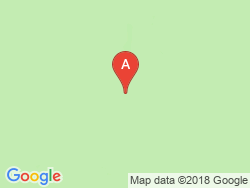
| GPS | N48.14166° E17.10006° |
| Date of last change | 06. 08. 2024 |
|---|
Attractions nearby
Show more tourist attractions


Attractions nearby


Our tips
64.50 €
69.50 €
28.50 €


HEPEX Slovakia s.r.o.
All rights reserved.
Webdesign Pixa.sk
Change cookie settings